
Encounter decision guide
Home / Events Guide / Man in the Fog
Should You Use a Flashlight on the Man in the Fog?
If you are asking, “should I use a flashlight for the Man in the Fog in Don't Sleep With The Fishes?”, the careful answer is: use it only when the visible prompt gives you a clear reason, or when you can afford a controlled test. Similarweb data confirms that players search this question; it does not prove which choice works in the game. This page separates a resource-safe recommendation from an unverified mechanic and gives you a repeatable way to check your own build.
Short answer
Should you use the flashlight?
There is no verified universal rule in the evidence available for this guide. Do not spend your only useful light source just because an encounter mentions fog. Read the exact on-screen choice first. If the prompt explicitly asks you to illuminate, signal, or inspect something, and your run can absorb the cost, using the flashlight is a reasonable test. If the prompt is vague or your supplies are already tight, keep the item and protect the run.
This is a conservative strategy, not a confirmed walkthrough answer. The available Similarweb result is a search-demand signal, not evidence about the game's mechanics. One successful attempt also does not establish a guaranteed route; the game version, companion, day, inventory, and exact event text may differ.
Before choosing
A resource check for the Man in the Fog encounter
Pause for a moment and decide whether this is a safe experiment or a run you are trying to preserve. A flashlight choice matters less than food, health, and a seaworthy boat if losing one of those ends the attempt. The table below is a decision aid, not a claim that a particular item triggers a scripted result.
| What you see | Safer next move | Evidence status |
|---|---|---|
| The prompt clearly names a light, signal, or visibility action | Use a spare flashlight only if hunger, health, and repairs are covered; record the outcome. | Practical test recommendation; exact outcome unverified. |
| The prompt only names a person or fog, with no clear action | Do not infer that the flashlight is correct from the encounter name alone. Preserve it or choose a non-item option. | Conservative resource advice. |
| The flashlight is your only reliable light or utility item | Keep it until the rest of the run is stable, unless the visible choice makes the cost and result explicit. | Risk management, not a game rule. |
| You have spare supplies and want to test the mechanic | Try one choice, note the item state before and after, and repeat under similar conditions before generalizing. | Controlled test method. |
| You are low on food, health, energy, or boat condition | Prioritize survival. Defer a curiosity run rather than risk a strong attempt for an unverified event result. | General survival priority; see the survival walkthrough. |
Read the state
Check the prompt and your supplies before using an item
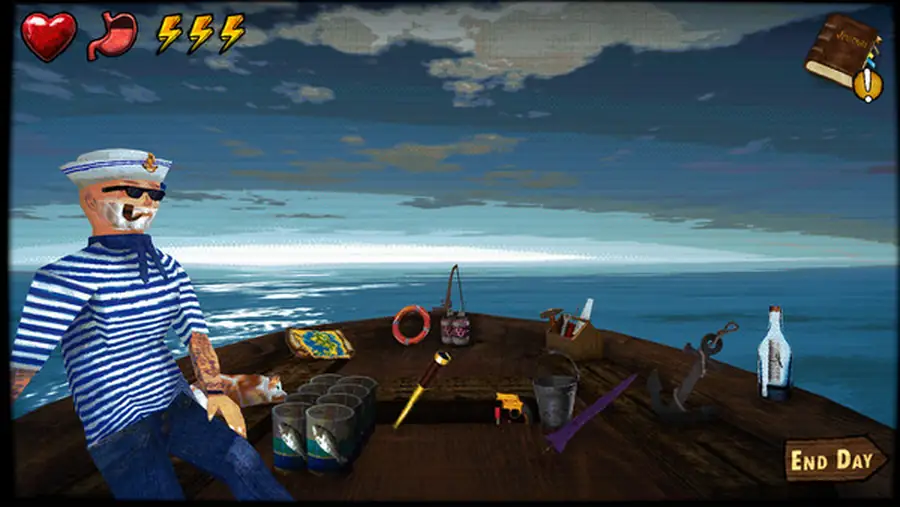
The scavenge phase is where a run's available tools and supplies become visible. Before an uncertain encounter, note what is actually in your inventory instead of relying on a remembered screenshot or a copied checklist. If you carry only one flashlight, its opportunity cost is different from a run with a spare.
Also record your food, health, energy, boat condition, and companion. Those details help explain why two players may report different outcomes. This gameplay screenshot shows the game's inventory context; it does not depict the Man in the Fog event.
Repeatable method
How to test the flashlight choice without guessing
Use this method when you have a stable run and want to learn whether the flashlight changes the Man in the Fog encounter. Keep the first run as a baseline. Change one uncertain choice at a time so you can tell which detail may explain a different result.
- Write down the starting state. Note the game source and version shown to you, day, companion, health, hunger, energy, boat condition, and whether you have one flashlight or more than one.
- Copy the encounter text. Record the prompt as it appears, including the available choices. Do not rename it from memory as “the fog event” if the game shows more specific wording.
- Make one choice. If the run can afford it, use the flashlight once. If it cannot, select the safest option for survival and leave the mechanic unresolved.
- Record both cost and result. Check whether the flashlight disappears, changes, or remains; then note the effect shown on screen and what happens to the crew and boat.
- Repeat only when safe. On another attempt, keep the companion and opening resources as similar as practical. Change only the flashlight decision. A matching result across repeated attempts is stronger evidence than one anecdote.
Example log format: version | day | companion | exact prompt | flashlight before | choice | flashlight after | visible result | confidence. Leave a field blank when the game does not show it. Mark a single observation as a lead, repeated matching observations as a pattern, and conflicting results as unresolved.
Protect the run
When to stop experimenting and return to survival
A route experiment is optional. If the next phase requires food, healing, repairs, or a dependable night response, spend resources on keeping the run alive first. A failed run can teach you something, but you do not need to sacrifice a strong attempt merely to settle one uncertain item interaction.
When an attempt ends, keep the notes even if the result was a loss. Record the cost of the choice separately from whether it appeared to help. This prevents “I used the flashlight and survived” from becoming “the flashlight always works.” For broader night preparation, see the Events guide; for item trade-offs, use the Items guide.
Common mistakes
What not to assume from one encounter
- Do not treat search volume as game evidence. It shows that people ask the flashlight question, not that the flashlight has a guaranteed effect.
- Do not turn one successful run into a fixed script. Record the exact prompt, version, companion, and item state before sharing a result as a route.
- Do not change several variables at once. If you swap the companion, item, and response together, the test cannot isolate the flashlight.
- Do not risk essential supplies for an optional discovery. A survival baseline is more useful than a secret result that ends the run before you can repeat it.
FAQ
Man in the Fog flashlight questions
Should I use a flashlight on the Man in the Fog?
There is no verified universal outcome in the evidence available for this guide. Use it when the visible choice clearly calls for light and your run can absorb the cost, or test it during a safe attempt. If the prompt is unclear and the flashlight is important to survival, keep it.
Does the flashlight always work for the Man in the Fog?
A guaranteed result has not been verified here. Compare repeated attempts with similar companions and starting resources, and copy the exact event wording. If the outcome changes, report the conditions instead of claiming a fixed rule.
Will using the flashlight consume it?
Do not assume either outcome. Check the inventory immediately before and after the choice. A visible change in one attempt is useful evidence for that run, but repeat it before assuming every build behaves the same way.
How do I test the Man in the Fog flashlight choice safely?
Start with a stable supply margin, record the event text and run state, change only the flashlight choice, and compare the result with another similar attempt. Stop if the experiment would put food, health, or repairs at risk.
Where can I find reliable Don't Sleep With The Fishes information?
The Steam store page and the developer's itch.io page are suitable for product and access facts. The Steam Community guides are player-generated leads, not automatic developer confirmation.
Sources and related guides
Keep the question in context
This guide does not claim a solved Man in the Fog item script. It uses Similarweb search-demand data to identify the question, game imagery for visual context, and a test procedure to avoid presenting unverified player reports as facts.
- Events guide for broad event preparation.
- Items guide for resource trade-offs.
- Survival walkthrough for a stable first-run plan.
Product references: Steam store page and developer itch.io page. Community guides remain user-generated.